Wednesday, May 17, 2017

What’s Happening

The Oriental Institute, Breasted Hall, 1155 E. 58th St, Chicago IL 60637 . Wed, Jun 7, 7–9pm, Andrew George, professor of Babylonian, University of London, School of Oriental and African Studies: The Epigraphic Survey at 93: Changing the Face of Archaeology with New Digital Technologies at Chicago House in Luxor, Egypt.

Oriental Institute, La Salle Banks Room, Wed. May 31, 12:00–1:00 PM: Lecture by
Emanuel Pfoh, Aspects of the Political Anthropology of the Southern Levant during the Late Bronze Age. CONICET / National University of La Plata, Argentina. Fulbright Visiting Research Fellow, the Oriental Institute, University of Chicago

Friday, April 14, 2017

April Meeting at Ceviche Restaurant, 2554 W Diversey.

Date: Sunday, April 30, 2017.
Place: Please Note Meeting change: The Ceviche Restaurant, 2554 W Diversey.
Time: 3:00 p.m. Social Hour: Refreshments and Fellowship .
Program: 3:30 p.m.

Presentation by our guest speaker: Ms. Margery al Chalabi, Comparing Gobekli Tepe with The Cliff Dwellers.


Gobekli-Tepe Exposed

...An architect’s Exploration of the archaeological site described by National Geographic as the “World’s First Temple”


Göbekli Tepe, near Sanliurfa, in South-central Turkey, is a 12,000 year old monument, which has changed the way historians, archaeologists and architects – have viewed the transformation to civilization from hunter/gatherer. The premise was, “we used to think it was agriculture which gave rise to cities and, later, to writing, art and religion. Now, Göbekli Tepe, the world’s oldest temple** (at 12,000 years) suggests the urge to worship sparked civilization—that, to an urban plan-ner, made the archaeology of Göbekli Tepe an irresistible study.

Margery al-Chalabi is an architect, urban planner/regional economist. After graduating from Carnegie Institute of Technology (Now Carnegie Mellon University), with a B. Arch, she traveled to Athens, Greece, on a Ford Foundation grant, and received an MSc in regional planning/economics from Athens Technological Institute. She has been involved in urban development projects, both public and private, for over fifty years.

After graduation the al-Chalabis came to Chicago, where Ms. Chalabi settled into Real Estate Research Corporation and there directed projects on neighborhood preservation for HUD, adaptive reuse projects for DOD and Interior, and downtown development studies/forecasts for the International Down-town Executives Association (IDEA) and the Cities of Cincinnati, Charlotte and South Haven. The al-Chalabi’s were both were invited to join the Mayor’s Office under Mayor Jane M. Byrne.

With Mayor Byrne’s loss, in 1983, they started the al Chalabi Group, Ltd.
(ACG). Their blend of public and pri-vate experience made for a practice together that endured for 32 years. Their most important projects includ-ed: saving and renovating the Chicago Theater; planning for the Third Chica-go Airport; providing forecasts and impacts for major transportation pro-jects; and developing landmark models and methodologies.

As a member of a large Iraqi family, and an officer and past President, of the international society, the World Society for Ekistics* (WSE,), Ms. Al Chalabi has returned to Greece, Iraq, Lebanon, and Turkey on many occasions. Since 2011, when she first learned of Göbekli Tepe from archaeo-logical magazines, Ms. al Chalabi has studied this site from afar and up close.

In April, 2016, she made a presen-tation of her 2013 exploration of the site to The Cliff Dwellers Club in Chi-cago. That presentation – with some updates – is the subject of the presenta-tion to the Chicago Archaeological Society on April 30, this year.

*The science of human settlement.

** “The World’s First Temple”, National Geographic, June 2011.

3,000-year-old city wrecked by ISIS is left for looters

The militants’ fanaticism devastated one of the most important archaeological sites in the Middle East. But more than a month after the militants were driven out, Nimrud is still being ravaged, its treasures disappearing, piece by piece, imperiling any chance of eventually rebuilding it, an Associated Press team found after multiple visits last month.


Bison and the Oneota II

The CAS and Codex are indebted to Dr. Robert Sasso its March Guest speaker and his topic, The Importance of the Bison in the Late Prehistoric Oneota Culture in the Upper Midwest. Our general knowledge of the Oneota is sketchy and deeper understanding of Oneonta life is wanting. An after-noon with Bob Sasso was an excellent way of filling-in some of the blanks.

We understand that whereas bison were a significant menu item for many settle-ments significant bison evidence is pri-marily found in at La Crosse, as well as in Lake Winnebago-Middle Fox and Lake Koshkonong Areas. At one time or another the vast bison range extended south from NW Canada beyond the Rio Grande and eastward across the Great Plains to Appalachia.
Bison Scapula Hoe

How have archaeologists determined bison consumption? A careful tabulation of bison bones and others can provide a workable ratio that offers insight but one that is general. Summer hunting safaris provided the hunters with surplus meat that was dried and collected as jerky, lean meat that has been trimmed of fat, cut into strips, and then dried to prevent spoilage. Jerky served to balance the diet and could have been trade item.

Where bison remains occur often found are modified scapula hoes—the scapula (shoulder blade) after some finessing and hafting served admirably as a hoe. The extensive span within which scapular hoes have been found attest to their popularity and utility.

CAS/Bison Ties: The Anker Site

Picture below are two bison, the one on the left is the CAS logo. The one on the right is taken from the Chicago area Archaeology Bulletin No. 3. the Bulletin cover was designed by Ms. Nancy Engle .


The Chicago Area Archaeology Bulletin No. 3 was published by the Illinois Archaeology Survey and edited by Elaine Bluhm whose contribution papers were The Anker Site co-authored by Allen Liss and The Oak Forest Site co-authored by Gloria J. Fenner.

Excavated in 1957 The salvage dig brought to view information of an unu-sual nature of individual wealth, organi-zation and evidence of considerable trade by its occupants over a probable period 1400—1500.

Among its finds was a stone pipes deco-rated with graven bison as illustrated below.

The Palimpsest Deb Stelton

We hear from you.

Our U.S. mail that we pick up from our mailbox on the road gets heavier and heavier.
Half of it, mostly catalogs, gets dumped into the recycle bin near the kitchen door. But some of it is from you. You send us folded up coffee-stained articles: "Newgrange, a Neolithic tomb site, older than Stonehenge" or "Statue Unearthed in Cairo May Be Ramses Likeness".

Some of the articles may contain general-ly known archaeologically known facts or theories. But an accompanying photo or some detail might be enlightening. The photo of the high long wall at the bottom of the hill at Newgrange with a fringe of ant-like waiting tourists is awesome and brings to mind the significance it once held for the locals.
Children playing around a piece of a stone head that might be Ramses II and crowds of Cairo citizens watching seg-ments being machine lifted from a hole in the ground, makes you wonder. Will the pieces be put together and will it help bring the tourists back to Egypt?

"Parched and Sinking Mexico City in Crisis" reveals parenthetically that the conquistadors "replaced the dikes and canals with streets and squares. They drained the lakes and cleared forests..." Today in Certain areas, women stand in line to purchase water.

"We couldn't Believe Our Eyes': Explor-ers find a Long Lost World of Ship-wrecks". The Black Sea turns out to be the best environment for preserving wooden vessels from medieval times and even earlier. One explorer, Robert D. Ballard found a "2,400 year old wreck laden with clay storage jars.... One held remnants of a large fish that had been dried and cut into steaks, a popular food in ancient Greece."

Did the Greek philosophers follow the _Mediterranean diet?

Articles came from Gloria Williams and Phyllis Adams

Monday, January 23, 2017

January Meeting Location Change

Date: Sunday, January 29, 2017 Members’ Night.
Place: Ceviche Peruvian Seafood & Steakhouse
2554 W Diversey Ave, Chicago, IL 60647
Time: 3:00 p.m. Social Hour: Refreshments and Fellowship .
3:15 p.m. Members Presentations and Election of Board and Officers.
Program: 3:30 Dr. Tasha K. Vorderstrasse, University of Chicago: Excavations at Abroyi, Armenia.

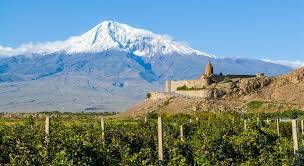
Exploring Armenia’s Hidden Past

Armenia is a small and mountainous country of peaks and high plateaus cut by river valleys. It was the first to embrace Christianity as a state religion.

Powerful old stone churches are silhouetted on the hilltops and tucked into the valleys at-testing to Armenian fortitude. Tragedy and triumph have become dual themes that are indelibly woven into the fabric of its history.
In 2013 and 2014, the Oriental Institute of the University of Chicago conducted excavations at the medieval village of Ambroyi in the Republic of Armenia. This excavation represent-ed an innovation in the study of medieval archaeology of Ar-menia, which had primarily focused on large urban centers.

The excavations revealed that village life continued in Armenia despite the Mongol conquest of the region in the 13th century and provides valuable information about vil-lage life that can be compared to villages that have been excavated in the wider region. This talk will discuss the vil-lage of Ambroyi and its significance to our understanding of Armenian archaeology of the medieval period.

Dr. Tasha K. Vorderstrasse received her PhD in Near Eastern Archaeology from the University of Chicago 2004. Her work concentrates on the material culture of the Near East, the Caucasus, and Central Asia and the interactions between these regions and China.

Most Americans have check-ered understanding of Armenia or Armenians. The history, at best is inscrutable. Ef-forts to grasp historical meaning of the Transcaucasus al-low for few exceptions. Transcaucasia roughly corresponds to modern Georgia, Armenia, and Azerbaijan.

In 1915, leaders of the Turkish government set in motion a plan to expel and massacre Ar-menians living in the Ottoman Empire. Though reports vary, most sources agree that there were about 2 million Armeni-ans in the Ottoman Empire at the time of the massacre.

By the early 1920s, when the massacres and deportations finally ended, some 1.5 million of Turkey’s Armenians were dead, with many more forcibly removed from the country. To-day, most historians call this event a genocide–a premeditated and systematic campaign to exterminate an entire people.

However, the Turkish government does not acknowledge the enormity or scope of these events. Despite pressure from Armenians and social justice advocates throughout the world, it is still illegal in Turkey to talk about what happened to Armenians during this era.

Members’ Night

The regular January meeting of the CAS traditionally has been designated as Members’ Night. Originally members had an opportunity to share their archaeological/travel experiences with the membership at large. Members’ Night targeted active participation along with the annual election of officers and election of 1/3 of the board of directors.

Gradually, over past years, presentations by members of personal experiences declined in favor of presentations by guest speakers, like Dr. Tasha K. Vorderstrasse, the January 2017 speaker.

Annual Election

Many sister chapters, especially in rural areas, where members have direct contact with local ongoing digs, reflect membership roles that include active lay archaeologists. By contrast CAS mem-bers regard Field and/or Oriental Institute as their closest contact with professional archaeologists. These differences help to explain and to define the cosmopolitan context of the CAS calendar.

The Board of Directors unanimously nominated current officers and board members for reelection at the October Meeting. The 2017 ballot is printed on page 3. However members are reminded and urged to nominate candidates from the floor.

The Palimpsest

Winter Woes
To our chagrin, disappointment and embarrassment December’s severe weather necessitated a sud-den cancellation of the December Holiday Luncheon and regular meeting. An effort was made to contact members, guests, and our speaker and was largely success-ful. A substitute date will be de-termined at our February Board Meeting. Unofficially the inten-tion of the board is to plan a new date. Deposits received will be applied to to the rescheduled event. However requests for re-funds will be honored.

An Archaeological Paradox
The paradoxical aspect of archaeology continue to confound my consciousness. Avid attention to archaeological journals and the internet are constant reminders of how current discoveries cast light upon a past previously unknown.

A business man, Heinrich Schliemann, acquired a fortune to in-dulge a romantic fantasy, to dis-cover Homer’s Troy. Schliemann’s experience was unique but not singular.
Much of our understanding of the ancient world remains hidden or lost.

To what extent is Western De-mocracy indebted to the Minoans or the Mycenaeans? Archaeolo-gists Jack Davis and Sharon Stocker excavating a site near the ancient Palace of Nestor, on a hilltop near Pylos on the south-west coast of Greece.

The very first organized Greek society belonged to the Mycenae-ans whose kingdoms exploded out of nowhere on the Greek mainland around 1600 B.C.E.

The Bronze Age palace, built by the Mycenaeans, had been previ-ously excavated, and hopes for additional understanding were low. But the Davis and Stocker dig discovered a rich warrior grave now dubbed The Grave of the Golden Warrior which would alter understanding of the Myce-naean role in the evolution Greek democracy.

A detailed account of the discov-ery, The Golden Warrior, A 3,500 Year-Old Tomb Exposes the Roots of Western Civilization, was pub-lished in Smithsonian, January-February, 2017.

The discovery has raised a few question. At the time of the inter-ment the tholos-tomb was the pre-ferred burial of the upper class.

And the Future

Search Engines can locate ongo-ing archaeological activity for the archaeological-bit-trekker. Try this link: http://www.livescience.com/57375-archaeology-stories-to-watch-in-2017.html . The link will lead you to a 5 point list of discoveries for 2017.

The list of 5 is somewhat disap-pointing insofar as it includes no surprises.

1. Is predicated on cessation of hostilities in Iraq and anticipation of returning the depredations of ISIS to order. 2. Suggestions that there is a Great Pyramid hidden chamber. 3. Anticipates addition-al Dead Sea Scroll discoveries. 4. Suggests that ongoing exploration of the necropolis of Abydos, Egypt will expand its importance. 5. The opening of the Bible Mu-seum may be worth watching. When this museum, with its vast collection, is open to the public in 2017, much will be revealed. Al-so, as scholars analyze the collection, many new discoveries will be made and some of the artifacts will turn out to be modern-day forgeries.